
Topics
From winter term 2025/26 on MAOT changes the structure from seven to four main topics. MAOT teaches applications of optical technologies in these four main topics. However, the ‚old‘ topics still play a role in the curriculum from time to time. They roughly translate into the new system as follows:
- Photonic Fibers, Materials and Devices <—> Optical Materials and Systems / Optics in Communication
- Photonics in Production and Process Technology <—> Optical Material Processing / Optical Metrology
- Biomedical Photonics and Image Data Processing <—> Optics in Medicine / Computational Optics
- Physics of Light <—> Physics of Light
Photonic Fibers, Materials and Devices
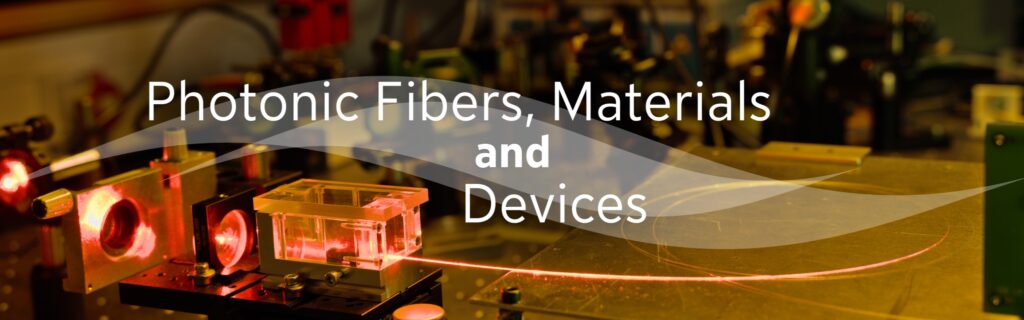
From photovoltaics and semiconductors to microstructured devices, glasses and molecular assemblies, Erlangen is a widely-known site for photonic material technologies. Research activities comprise the fabrication and the characterization of innovative photonic structures and their implementation into prototype as well as large-scale applications.
Around 30 research groups focus on the design of light-absorbing and emitting materials, laser-treated glasses, microresonators and molecular machines, as well as on their investigation using approaches such as state-of-the-art spectroscopy, electron microscopy, or X-ray tomography. In addition, Erlangen is one of the world’s leading spots for research on photonic crystal fibers.
Photonics in Production and Process Technology
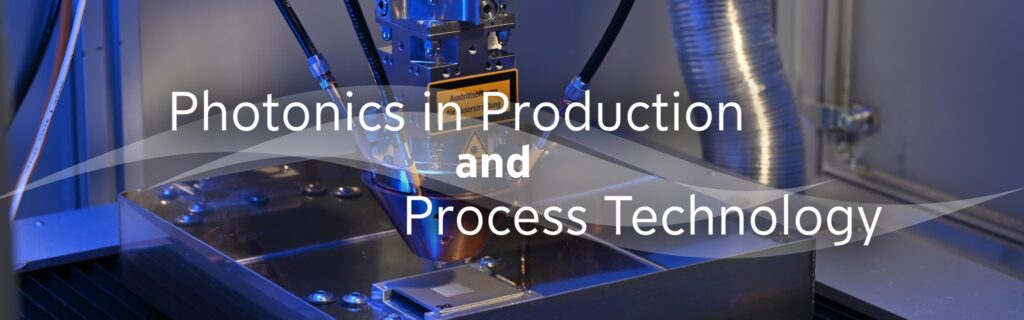
Multiple well-established production techniques and analytical methods would not have been developed without the possibilities that emerge from photonics. Almost 20 research groups located in Erlangen have major contributions to this technological progress.
This not only includes state-of-the-art laser processing of various material systems, experimental and theoretical lithography or modeling of complex systems, but at the same time also advances in a plethora of metrology approaches comprising interferometry, different kinds of spectroscopy, sensing of fluids and gases, determination of surface and particle properties and much more. This diversity renders Erlangen as a hotspot in next generation production and process technology based on photonics research.
Biomedical Photonics and Data Processing
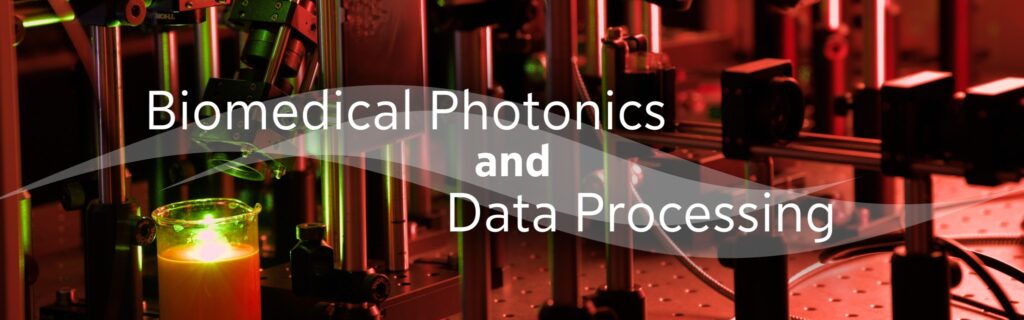
Visualizing and influencing biological structures and processes using photonic technologies is a both challenging and promising field of research. It spans from fluorescence spectroscopy of human tissue and in-vivo endo-microscopy to opto-biomechatronics and optogenetics. Further, artificial intelligence and deep learning algorithms play an increasing role in data processing, pattern recognition and classification in medical imaging, e.g. in MRT diagnostics.
Future healthcare and medical applications based on photonic technologies developed by more than 30 research groups in Erlangen accelerate and improve diagnoses and therapies on many kinds of diseases.
Physics of Light
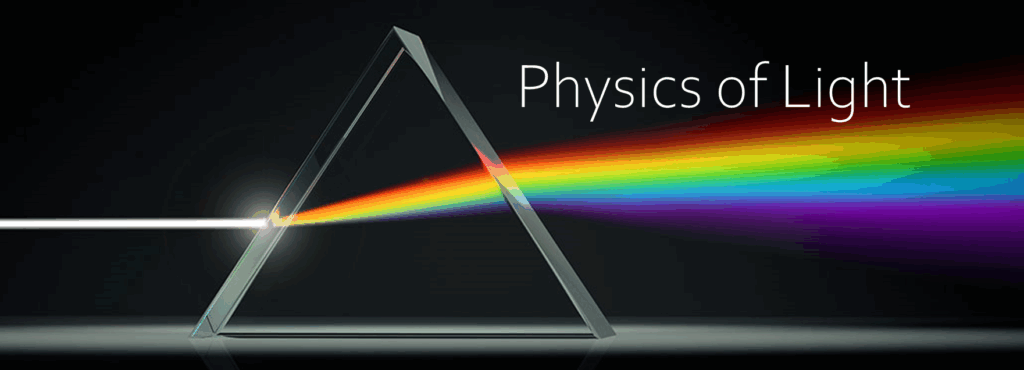
The learning outcome of the major topic ‚Physics of light‘ is for students to acquire knowledge on the physics behind optical technologies, that goes beyond the foundation modules (geometrical optics, wave optics, Fourier optics, non-linear optics, quantum optics).
Students gain physical knowledge in the field of optics beyond the areas covered in the fundamental courses in the first semester. They learn to apply their theoretical knowledge to analyse and solve optical problems, design and conduct experiments in optical physics and develop physical concepts.
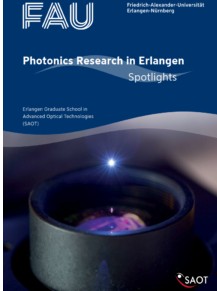
Photonics Research in Erlangen
Find out more about Photonics Research in Erlangen in the online brochure provided by the SAOT Erlangen Graduate School in Advanced Optical Technologies